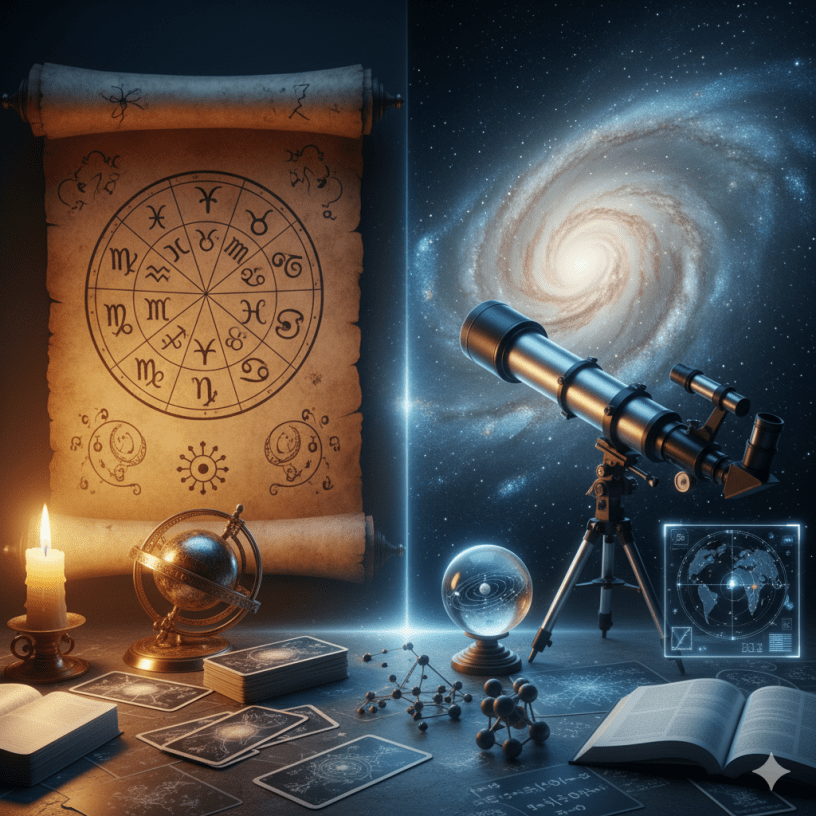
The night sky has captivated humanity for millennia. Yet, in our modern world, we face a crucial distinction: are we looking up for guidance (astrology) or for understanding (astronomy)? The time has come to definitively shift our focus from ancient beliefs to the powerful, evidence-based science of astronomy.
This isn’t just about semantics; it’s about embracing scientific literacy over pseudoscience. Astronomy has sent rovers to Mars and peered into the dawn of the universe, while astrology remains rooted in a flawed, centuries-old model of the cosmos.
The Astronomical Flaws That Break the Zodiac
Astrology claims that the position of celestial bodies at your moment of birth influences your personality and future. However, a look through the lens of modern astronomy reveals fundamental, irreconcilable inconsistencies.
1. The Precession Problem: Aries is Not Where You Think It Is
The single biggest blow to modern astrology is the precession of the equinoxes.
- The Earth’s axis has a slow, 26,000-year wobble, much like a spinning top slowing down.
- Astrological systems were codified over 2,000 years ago. Since then, this wobble has caused the entire zodiacal cycle to shift by nearly a full sign.
- The Reality: If you were born a “Gemini” according to a current horoscope chart, the Sun was likely situated in the constellation of Taurus during your birth. The entire system is out of sync with the sky we observe today.
2. The Missing Constellation: Hello, Ophiuchus!
Astrology neatly divides the sky into 12 equal, 30-degree segments. The physical reality of the constellations along the ecliptic (the Sun’s apparent path) is very different.
- The Sun actually passes through 13 different constellations, not 12.
- The constellation of Ophiuchus, the Serpent-Bearer, sits squarely on the ecliptic for a significant portion of the year but is arbitrarily ignored by most Western astrology to maintain the tidy 12-sign calendar. This arbitrary exclusion is a clear admission that the system prioritizes neatness over accuracy.
3. Unequal Sizes, Equal Angles: A Mathematical Error
Astrology treats every sign as a neat 30-degree slice of the sky. This is not how the constellations are actually shaped.
- Some constellations are huge, and the Sun spends a long time passing through them (e.g., it spends about 45 days in Virgo).
- Others are tiny, and the Sun passes through them quickly (e.g., it spends only about 7 days in Scorpius).
By imposing a rigid, equal 30-degree angle on vastly unequal constellations, astrology chooses a convenient but physically inaccurate model of the cosmos.
The Power of Astronomy: Why Science Triumphs
Moving away from the inconsistencies of astrology means moving towards a framework that offers real-world knowledge and progress.
Fostering Critical Thinking
Astronomy demands empirical evidence and repeatable tests. It encourages us to ask, “How do we know?” instead of “What do the stars say?” This promotion of critical thinking is essential for navigating the complex information landscape of the 21st century.
Driving Innovation and Technology
The pursuit of astronomy is a massive driver of technological advancement. Every time we build a powerful new telescope or launch a probe, we push the limits of engineering.
- Optics: Precision lenses and mirror technology.
- Data Processing: Handling and analyzing terabytes of astronomical data.
- Rocketry and GPS: The science of getting a machine into orbit powers everything from weather prediction to global navigation.
A Deeper Understanding of Our Place
While astrology offers personal guidance, astronomy offers a profound, evidence-based perspective on humanity’s place in the universe. It teaches us about the cosmic origins of the elements that make up our bodies, the scale of galaxies, and the precious uniqueness of our own planet.
✨ Embrace the Cosmos, Scientifically
In today’s world, we have access to the most powerful instruments and knowledge in human history. We can see black holes merging, find exoplanets, and map the early universe.
Let’s reserve our wonder for the discipline that seeks the truth of the cosmos—astronomy—and leave the arbitrary and factually incorrect star signs behind.
Ready to start your scientific journey? Find a local star party or check out NASA’s latest image of the day. The universe is far more amazing than any horoscope could ever predict!
 Prince Wealth