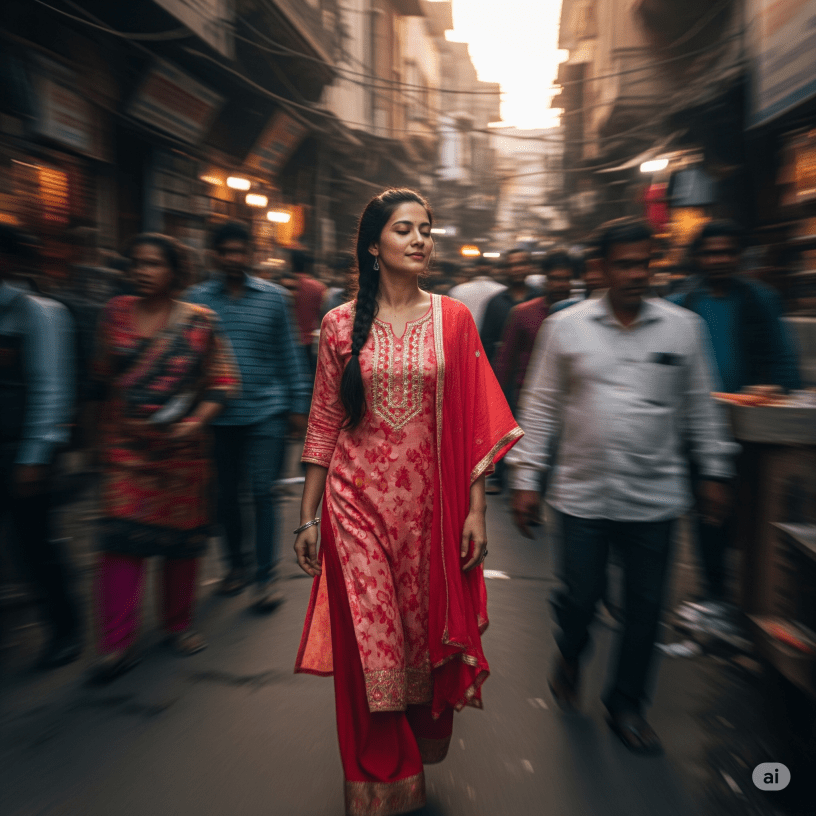
The year is 2025, and the city of Delhi pulsates with an energy that often verges on overwhelming. Roads are perpetually choked, bureaucratic processes are labyrinthine, and social divisions, though often unspoken, run deep. Yet, amidst this dense reality, lived a woman named Leela, who embodied the principle of Apratihatagāmī – unimpeded penetration.
Leela worked as a conflict mediator, a profession that, in Delhi, was less about arbitration and more about navigating an endless maze of emotional barricades, historical grievances, and sheer stubbornness. Most mediators would spend weeks, even months, chipping away at the walls people built around themselves. But Leela was different.
Her day began not with a strategy session, but with a quiet understanding of the ‘flow’ of the city. She didn’t see traffic jams as obstacles but as temporary convergences of individual intentions. She didn’t see closed doors as barriers but as points where energy was momentarily static.
One particularly fraught case involved a long-standing land dispute between two prominent families in Old Delhi, a dispute so entrenched it had spilled into the courts for generations, causing riots and deep-seated animosity. The families refused to even be in the same room. Lawyers had thrown up their hands.
Leela arrived at the first separate meeting, not with a briefcase full of documents, but with a presence that seemed to subtly shift the very air. She listened intently to the first family, allowing their torrent of grievances, accusations, and historical injustices to wash over her. Where others would see impenetrable anger, Leela perceived the raw, unexpressed fear and longing for dignity beneath. It was as if their emotional walls, so solid to others, were porous to her. She didn’t challenge their narrative; she simply understood it, not just intellectually, but viscerally.
Then, she did something unconventional. She didn’t try to argue or counter. Instead, she began to speak, not about solutions, but about the essence of their shared humanity. She spoke of the universal desire for peace, for family, for legacy. Her words weren’t forceful, yet they seemed to bypass the layers of resentment and mistrust, directly touching something fundamental within them. It was as if her voice, and the intention behind it, could penetrate any mental or emotional barrier.
When she met with the second family, the same phenomenon occurred. They, too, felt an inexplicable sense of being truly heard, their pain acknowledged without judgment.
The breakthrough came when Leela suggested a joint meeting, an idea previously met with outright scorn. Yet, when she proposed it, her quiet certainty seemed to dissolve their ingrained resistance. In the meeting, tensions were palpable. But Leela didn’t attempt to force reconciliation. Instead, she focused on their shared vulnerability, their mutual exhaustion from the conflict. She subtly guided the conversation away from “who was right” and towards “what was needed for true peace.”
She spoke of the land itself, not as property to be owned, but as a shared heritage, a source of life that had nourished generations of both families. It was as if her understanding could penetrate the very concept of ownership, revealing a deeper connection. Slowly, haltingly, the impenetrable walls began to crumble. Not through force, but through an effortless penetration of perception and intention.
By the end of the day, not all issues were resolved, but the hostility had dissipated. For the first time in decades, the families agreed to genuinely negotiate. Leela hadn’t “broken down” barriers; she had simply moved through them, acknowledging their presence but never allowing them to impede her true purpose.
Whether she was navigating Delhi’s notorious traffic with uncanny ease, finding the simplest route through bureaucratic labyrinths, or dissolving the most stubborn human conflicts, Leela’s life was a testament to Apratihatagāmī. She didn’t fight the obstacles; she understood them so completely that they simply ceased to be obstacles at all, allowing her to move through reality with an unimpeded grace that inspired profound change.
 Prince Wealth