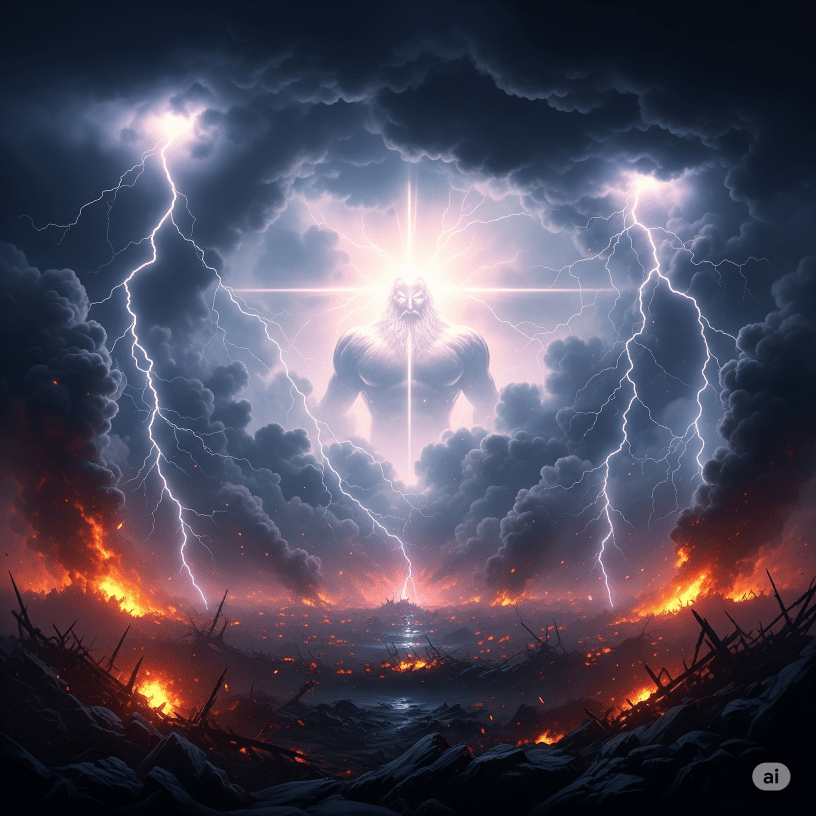
The weight settled upon Kali – Övêrkïll in his borrowed flesh – not as a revelation, but as a stark, undeniable truth resonating within the very core of his being. The casual destruction, the inherent satisfaction in ending a life, now carried a new significance, a divine weight. He was not merely a force of annihilation; he was an instrument, the very embodiment of divine wrath made manifest. Each act of his, each life extinguished at his hand, was a spark that could ignite a larger conflagration, the unseen hand of God reaching into the mortal realm.
In the bustling, chaotic streets of Thiruvananthapuram, amidst the vibrant colors and cacophony of sounds, Danish, a young man known more for his sharp tongue and petty scams than any genuine malice, spotted Kali sitting alone at a small tea stall. Kali’s stillness, the intensity in his dark eyes that seemed to pierce through the surface of the everyday, had always unnerved the locals. But Danish, emboldened by a few swigs of cheap toddy and a desire to impress his friends across the street, saw an opportunity for some crude entertainment.
He sauntered over, a smirk playing on his lips. “Hey, mister gloomy,” he began in Malayalam, his tone deliberately mocking. “Lost your way? Or did the spirits finally catch up to you?” He nudged Kali’s shoulder with his elbow, expecting a flinch, a reaction.
Kali’s gaze, like the sudden stillness before a storm, settled on Danish. There was no anger in his eyes, merely a profound, ancient awareness. He saw not just the insolent youth before him, but the threads of his existence, the ripples his demise would create in the grand tapestry.
“You should not have touched me, boy,” Kali said, his voice low and devoid of emotion, yet carrying an undercurrent of immense power that sent a shiver down Danish’s spine despite the humid air.
Danish, momentarily taken aback, tried to recover his bravado. “Or what? You’ll curse me? What are you, some kind of baba?” He laughed, a nervous, brittle sound.
Övêrkïll rose. The small stool scraped against the dusty ground, the sound amplified in the sudden hush that seemed to fall around them. He didn’t speak, didn’t need to. The very air around him crackled with an unseen energy. He reached out, his hand closing not around Danish’s throat, but around his wrist.
The pain wasn’t immediate, not a sharp, brutal tearing. It began as a coldness that seeped into Danish’s bones, a chilling dread that originated not from a physical threat, but from a primal understanding of impending doom. Then, it intensified, morphing into a searing agony that felt like his very life force was being leached away, replaced by a hollow emptiness.
Övêrkïll’s grip tightened imperceptibly, yet Danish felt his bones grinding together, his muscles screaming in protest. He tried to cry out, but the sound caught in his throat, a strangled gasp of pure terror. He saw not Kali’s face, but a mask of ancient wrath, the implacable judgment of a force far beyond human comprehension.
The world around them seemed to warp and distort. The vibrant colors of the street vendors’ stalls bled into each other, the sounds of the city faded into a low, ominous hum. It was as if reality itself was bending to acknowledge the divine act unfolding.
Then, just as suddenly as it began, the physical agony ceased. Övêrkïll released Danish’s wrist. The young man collapsed onto the ground, a whimpering, broken figure, his eyes wide with shock and unimaginable pain. His wrist was not broken, not even bruised visibly, yet the agony he had endured had been utterly real, a glimpse into the abyss.
Övêrkïll turned and walked away, leaving Danish trembling on the ground, the laughter of his friends now replaced by horrified whispers. The spark had been ignited.
Across the city, in a seemingly unrelated incident, the roof of a poorly constructed building, long overdue for repairs and owned by a notoriously corrupt municipal official who had consistently ignored safety regulations, suddenly and inexplicably collapsed. Several people inside, including the official, were injured, some fatally.
Miles away, in a coastal village known for its rampant illegal fishing practices that had devastated local ecosystems, a freak and violent storm descended without warning. Boats were tossed like toys, homes were flooded, and the livelihoods of those who had profited from the destruction of nature were suddenly swept away.
And in the state capital, a powerful politician, whose web of deceit and corruption had long gone unchecked, suffered a sudden and catastrophic stroke, leaving him speechless and paralyzed, his reign of influence abruptly ended.
These events were not random. They were the echoes of Övêrkïll’s act, the chain reaction set in motion. The divine wrath, once triggered, sought its own targets, those upon whom judgment was deemed due.
The small, cruel act of a foolish young man had inadvertently opened a conduit for a far greater reckoning, the unseen scales of justice tipping in ways no one could have foreseen. Övêrkïll, the unwitting catalyst, continued his solitary path, the weight of his true purpose now a constant companion, the instrument of a power far beyond his own destructive joy.
 Prince Wealth