The scent of cardamom and rosewater still clung to the air, a faint echo of the Eid feast we had just shared. My cousin, Farah, had opened her home, a warm, bustling haven, to our sprawling family. Laughter, stories, and the gentle clinking of teacups had filled the rooms, a perfect culmination of a month of fasting and prayer. But as the sun dipped below the horizon, casting long, eerie shadows, a subtle disquiet began to settle over us.
It started with a flicker, a momentary dimming of the lights that everyone dismissed as a power surge. Then, the whispers began. Not audible words, but a chilling undercurrent, a sense of something unseen shifting in the corners of the room.
A cold draft, despite the closed windows, sent shivers down my spine. Farah’s youngest, little Amina, usually a bundle of giggles, began to cry, pointing to an empty space behind the sofa, her eyes wide with terror.
Aunt Safiya, her face pale, gripped my hand. “Something is wrong,” she murmured, her voice barely a breath. “I feel it.”
The atmosphere thickened, becoming heavy, oppressive. The joyful energy of the day was replaced by a palpable dread. The air crackled with an unseen tension. My other cousin, Kamal, began to pace, his brow furrowed, muttering verses from the Quran under his breath.
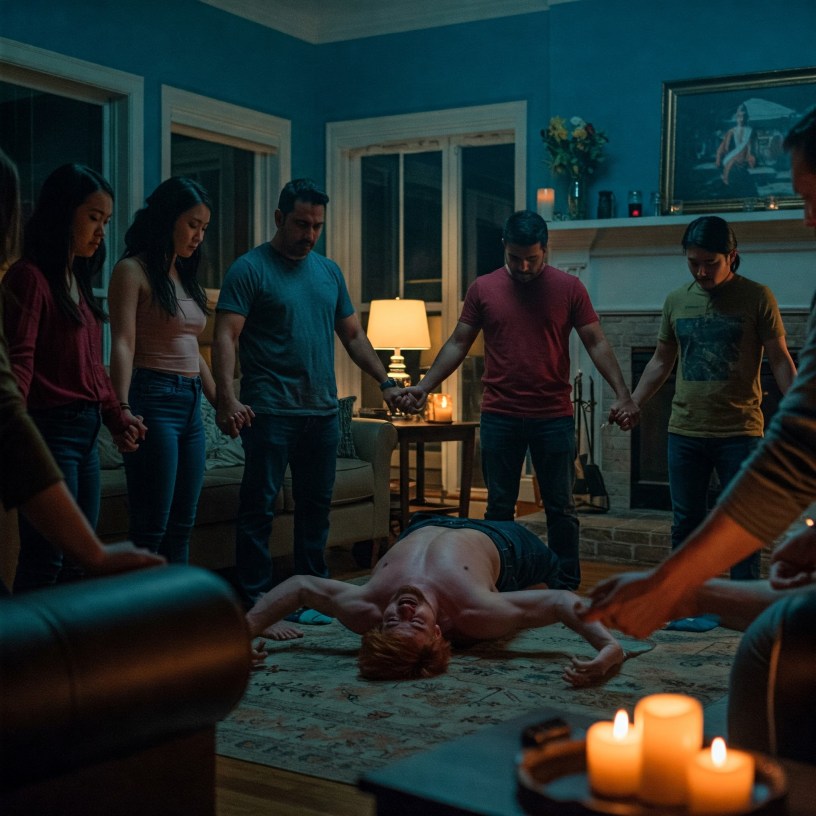
Suddenly, Farah’s eldest, Zaid, began to convulse, his body writhing on the floor. His voice, usually gentle and melodic, was now a guttural growl, a language I didn’t recognize. Fear, raw and primal, gripped my heart. This was no ordinary fit. This was something else.
Kamal, his voice now firm and resolute, declared, “It’s a Djinn. It has possessed Zaid.”
The room fell silent, the only sound Zaid’s horrifying cries. We huddled together, a mixture of terror and disbelief swirling within us. We had heard stories, whispers of such things, but never had we witnessed it firsthand.
Uncle Rashid, the eldest, a man of quiet strength and deep faith, took charge. He instructed us to form a circle, to hold hands, and to recite the Ayat al-Kursi, the Verse of the Throne. His voice, though trembling slightly, was filled with unwavering conviction.
As we chanted, the room seemed to vibrate, the air growing colder, heavier. Zaid’s cries intensified, his body thrashing violently. A dark, acrid smell filled the room, making our eyes water.
Kamal, his face pale but determined, stepped forward, holding a small bottle of rosewater infused with saffron. He began to sprinkle it around Zaid, reciting verses from the Quran in a powerful, resonant voice.
“Bismillah,” he chanted, “In the name of Allah, the Most Gracious, the Most Merciful. Leave this vessel, O cursed one. You have no place here.”
Zaid’s screams reached a fever pitch, a horrifying symphony of pain and rage. The lights flickered violently, then plunged us into darkness. A collective gasp filled the room.
Then, just as suddenly, the screams stopped. The darkness lifted, replaced by a soft, warm glow. Zaid lay still, his breathing ragged but steady. He opened his eyes, his gaze confused, but clear.
“What happened?” he whispered, his voice weak.
Kamal, his face etched with exhaustion, knelt beside him. “You were unwell, my brother. But you are safe now.”
Uncle Rashid stepped forward, his eyes filled with compassion. “The Djinn has been expelled, by the grace of Allah.”
We gathered around Zaid, our relief palpable. But the ordeal was far from over. The residual energy, the lingering darkness, still clung to the room, a heavy presence.
Uncle Rashid instructed us to continue reciting the Quran, to fill the room with the light of divine words. He brought out a small brazier, filled with burning frankincense and myrrh, its fragrant smoke swirling around us, cleansing the air.
For hours, we chanted, our voices rising and falling in unison, a chorus of faith and resilience. The room slowly began to lighten, the oppressive energy dissipating. The fear that had gripped us was replaced by a profound sense of peace.
As dawn approached, the first rays of sunlight filtering through the windows, we felt a collective sigh of relief. The ordeal was over. The Djinn was gone, banished by the power of our faith.
We embraced each other, our hearts overflowing with gratitude. We had faced the darkness, and we had emerged stronger, our faith reaffirmed. We had witnessed the power of the divine, the ability of light to overcome darkness.
The Eid celebration, once joyful, had become a testament to the strength of our community, our faith, and the enduring power of divine intervention. It was a reminder that even in the face of unimaginable darkness, the light of Allah’s grace could prevail. The celebration was no longer just about food and family, but about the resilience of the human soul, strengthened and purified by the divine.
The event had etched itself into our collective memory, a profound experience that would forever bind us together. The smell of the incense, the recitations of the Quran, and the collective fear and relief, all became a part of our shared history. It was a Ramadan Eid that would be remembered not for the feast, but for the spiritual battle waged and won.
 Prince Wealth