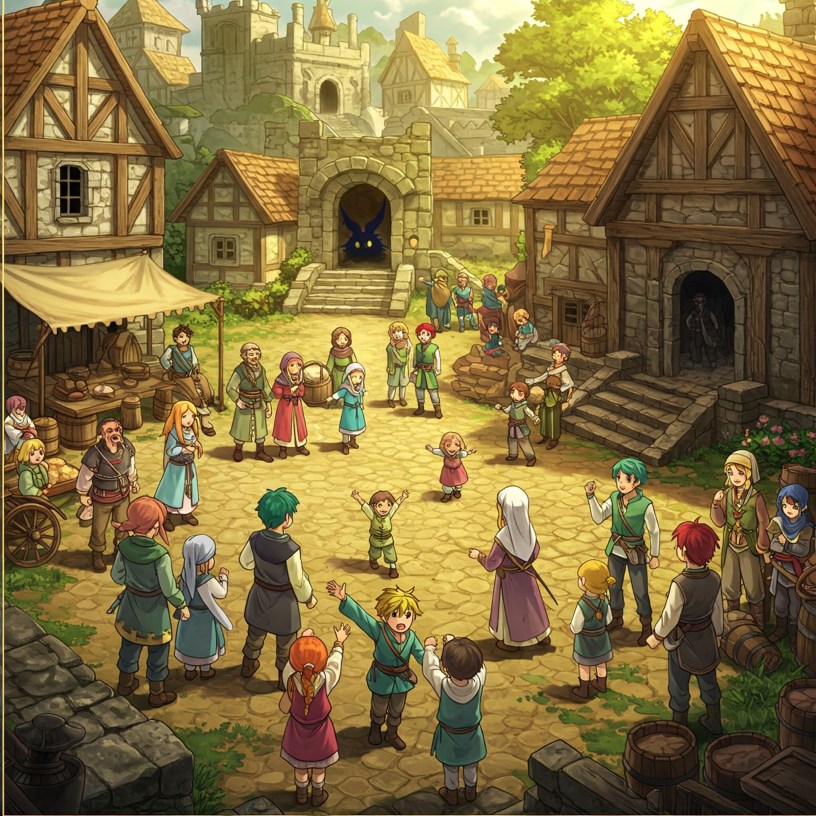
The village of Eldoria nestled in a valley shrouded in perpetual twilight, a place where whispers of ancient magic clung to the gnarled branches of ancient trees. At its heart resided a figure of dread, a black magician named Malkor, whose reputation preceded him like a chilling wind. Malkor, a man consumed by the reflection of his own perceived grandeur, wielded his supposed powers with a cruel and capricious hand. His magic, a dark tapestry woven from half-truths and theatrical pronouncements, held the villagers captive in a web of fear.
Malkor claimed dominion over the celestial dance of stars, the arcane energies of forgotten rituals, and the very threads of fate itself. He spoke of astrological alignments, invoking constellations with dramatic gestures, and muttered incantations that sounded like the rustling of dry leaves. Those who dared to question his authority or cross his path found themselves ensnared in his curses, whispers of misfortune that lingered like a persistent shadow. Some suffered from inexplicable illnesses, others from sudden reversals of fortune, and a few were said to have lost their very minds, their eyes vacant and their speech incoherent.
The villagers, steeped in generations of superstition, were paralyzed by fear. They lived in a state of perpetual anxiety, their lives governed by the whims of Malkor’s capricious magic. The once vibrant marketplace was now subdued, the laughter of children replaced by hushed murmurs. The fear was a tangible entity, a heavy cloak that stifled their spirit.
Into this atmosphere of dread arrived Dr. Elias Thorne, a man of the modern age, a scholar of the mind and the cosmos. He was a parapsychologist, a student of the enigmatic workings of the human psyche, a master of neuroplasticity, a scientist of neuroscience, a skilled hypnotist, and an astronomer who mapped the stars with meticulous precision. He had heard tales of Eldoria’s plight, of the black magician who held the village in thrall, and he felt a profound sense of responsibility to intervene.
Elias, armed with the tools of scientific inquiry and a deep understanding of the human mind, saw Malkor’s magic for what it was: a carefully constructed illusion, a performance designed to exploit the villagers’ fear and ignorance. He understood the power of suggestion, the malleability of perception, and the neurological basis of belief. He recognized that Malkor’s curses were not supernatural pronouncements but psychological manipulations, exploiting the inherent vulnerabilities of the human mind.
Elias, with his calm demeanor and piercing intellect, challenged Malkor to a duel, a contest of “magic” to be held in the village square on the coming Sunday. The villagers, their hearts pounding with a mixture of hope and fear, gathered to witness the confrontation. They watched as Elias, with a quiet confidence, set up his instruments: telescopes, charts, and apparatus that seemed to hum with unseen energy.
Sunday arrived, and the village square was a sea of anxious faces. The sun, a rare visitor in Eldoria, cast long shadows as the villagers waited for Malkor’s arrival. But the black magician did not appear. Hours ticked by, and the tension in the air grew thick and heavy. A small group of villagers, emboldened by Elias’s presence, ventured to Malkor’s dwelling, a dark and imposing structure on the outskirts of the village.
They found Malkor slumped in his chair, his eyes closed, his face serene. He was dead. There were no signs of struggle, no marks of violence, only the stillness of death. The village was stunned. The great Malkor, the master of dark magic, had simply passed away, his life extinguished like a flickering candle.
The villagers, initially bewildered, began to realize the implications of Malkor’s sudden demise. The fear that had held them captive for so long began to dissipate, replaced by a sense of liberation. Elias, with his understanding of the human mind and his knowledge of the natural world, had inadvertently broken the spell that Malkor had cast over the village.
Elias explained to the villagers that Malkor’s “magic” was a carefully crafted illusion, a performance designed to exploit their fears and superstitions. He showed them how the human mind, susceptible to suggestion and prone to confirmation bias, could be easily manipulated. He spoke of the power of neuroplasticity, the brain’s ability to rewire itself, and how belief could shape reality. He demonstrated how Malkor’s astrological predictions were based on basic astronomical understanding, and how easily a person can be fooled with simple hypnotic techniques.
He also explained that Malkor’s demise was likely due to natural causes, perhaps a heart attack or a stroke, exacerbated by the stress of maintaining his elaborate charade. The villagers, their minds opened to the possibilities of reason and logic, began to see the world in a new light.
Elias, with his gentle guidance, helped the villagers to reclaim their lives, to shed the shackles of fear and superstition. He taught them about the power of their own minds, the resilience of the human spirit, and the importance of critical thinking. He showed them how to observe the stars with scientific precision, not fearful awe.
The village of Eldoria, once shrouded in darkness, began to emerge into the light. The marketplace once again buzzed with activity, the laughter of children echoed through the streets, and the villagers, their eyes filled with newfound hope, looked to the future with renewed optimism. The fear was gone, replaced by a sense of empowerment, a realization that they were not at the mercy of dark forces but masters of their own destiny.
Elias Thorne, the man of modern science, had not only saved the village from Malkor’s curse but had also illuminated their minds, freeing them from the darkness of ignorance. He had shown them that the true magic lay not in arcane rituals or celestial pronouncements but in the power of the human mind, the boundless potential of the human spirit, and the unwavering light of reason.
 Prince Wealth