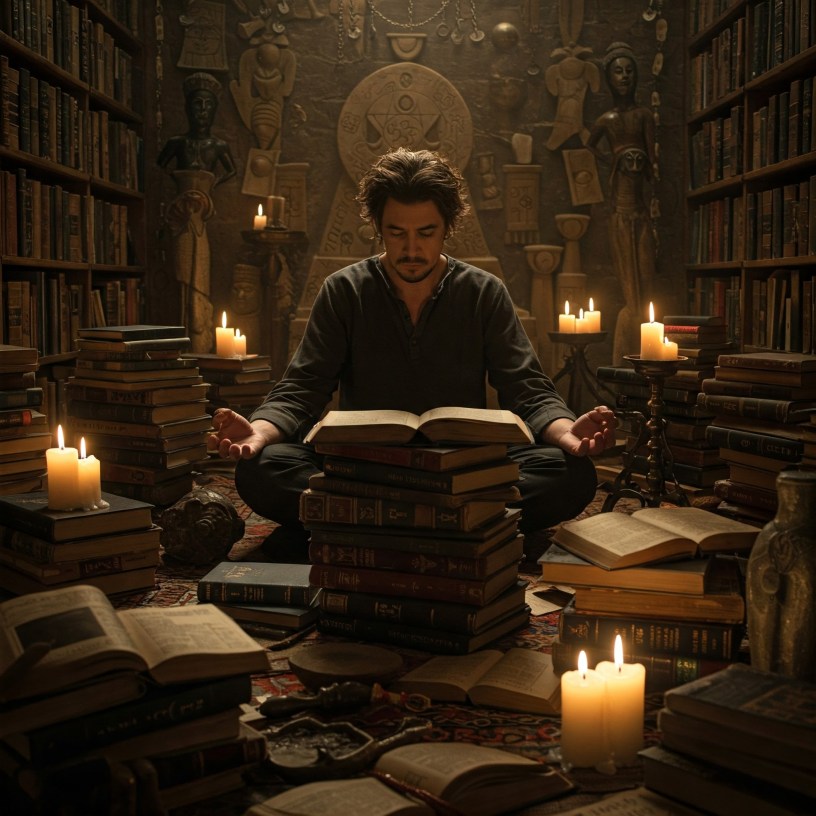
Yeliel, a man of unremarkable origins, harbored an extraordinary belief: he was touched by divinity. Not merely inspired, but imbued with the very essence of angelic power. This conviction became the cornerstone of his existence, fueling an insatiable hunger for spiritual knowledge. He devoured texts with a fervor bordering on obsession.
His library was a chaotic tapestry of faiths and philosophies. The Bhagavad Gita sat beside the Quran, the Bible nestled against the Book of Enoch, and ancient Vedic hymns echoed alongside whispers of voodoo and shamanic rituals. He delved into the Emerald Tablets, seeking alchemical secrets, and explored the shadowy corners of occult practices, his mind a swirling vortex of esoteric information.
Yeliel’s obsession grew, transforming from a quest for understanding into a yearning for absolute power. He convinced himself that he was destined for godhood, that the divine spark within him could be fanned into a celestial flame. He envisioned a world where he, Yeliel, would stand as the sole deity, the ultimate arbiter of reality.
He began meticulously planning a ritual, a grand alchemical and sorcerous undertaking that would elevate him beyond the constraints of mortality. He poured over his accumulated knowledge, extracting fragments of ancient rites, weaving them into a tapestry of arcane practices. He sought to create a ritual that would bypass the need for any existing divine power, or any devilish opposition.
His preparations were elaborate and obsessive. He gathered rare ingredients, chanted forgotten incantations, and drew complex sigils on the floor of his secluded chamber. He worked tirelessly, driven by a conviction that bordered on madness.
The night of the ritual arrived, charged with an eerie stillness. The air crackled with unseen energies as Yeliel began his incantations, his voice a low, resonant hum that filled the room. The sigils glowed with an otherworldly light, and the ingredients shimmered with an ethereal luminescence.
The ritual reached its climax, a crescendo of arcane power that shook the very foundations of reality. Yeliel felt a surge of energy coursing through him, a sensation of boundless power that threatened to overwhelm his senses. He believed, as he has always believed, that he had succeeded.
The room was bathed in a blinding light, and then, silence. Yeliel stood, his heart pounding, his mind reeling from the intensity of the experience. He felt different, changed, imbued with an undeniable sense of mastery.
He looked around, expecting to see the world transformed, but it remained unchanged. The walls of his chamber were still the same, the furniture unmoved. He felt a flicker of doubt, a momentary tremor in his unwavering belief.
But he quickly dismissed it. He was a god now, he reasoned, and the world would bend to his will in time. He stepped out of his chamber, ready to reshape reality in his image.
As he walked, he felt a strange sense of lightness, a feeling of being unburdened. The sun seemed to shine brighter, the air felt fresher, and the world appeared to be filled with an almost overwhelming sense of peace.
He noticed people smiling at him, their faces radiating warmth and contentment. He heard birds singing, their melodies filled with a joy he had never perceived before. The world seemed to be in perfect harmony.
He realized then, with a jolt of understanding, that his ritual had succeeded, but not in the way he had imagined. He had not become a god of dominion, but a catalyst for universal harmony.
The ritual had not granted him power over the universe, but rather, had aligned his own existence with the inherent harmony of reality. His obsession with control had been transmuted into an acceptance of the natural order.
The universe, it seemed, had no need for a single, controlling deity. It functioned perfectly, beautifully, in its own intricate dance of balance and interconnectedness. His role was not to rule, but to be a part of that dance.
His life, once a turbulent quest for power, became a serene journey of understanding. He no longer sought to impose his will on the world, but to appreciate its inherent beauty and complexity.
He found joy in the simple things: the warmth of the sun, the gentle breeze, the laughter of children. He understood that true happiness lay not in control, but in acceptance and harmony.
The problems and worries that had once plagued him faded away, replaced by a sense of deep contentment. He lived in harmony with the universe, his existence a testament to the transformative power of acceptance.
The world was not his to rule, but his to cherish. He understood that true divinity lay not in power, but in the ability to find peace within oneself and with the universe. And in that, he found his celestial success, and his journey fulfilled.
 Prince Wealth