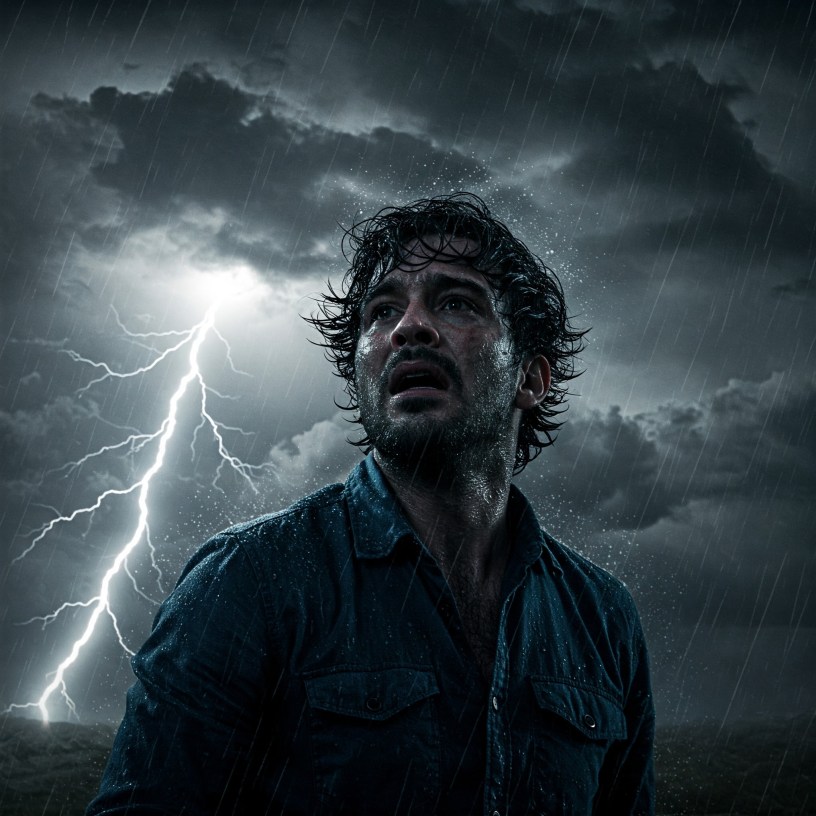
In a world shrouded in fear and uncertainty, the people of Earth trembled under the wrath of Uriel, the archangel of weather, whose name translates as “Fire of God”. Legends spoke of his fiery temper, his power to unleash storms of unimaginable fury, and his disdain for humanity. But amidst the chaos, a lone hero emerged, a man named Elias, whose courage and unwavering faith would challenge the very essence of Uriel’s wrath.
Elias, a humble farmer, lived a simple life in a small village nestled amidst rolling hills. He was a man of deep faith, his heart filled with love for his family and a profound respect for the natural world. Unbeknownst to him, his destiny was intertwined with the enigmatic Uriel, a being of celestial power and unwavering judgment.
As the years passed, the whispers of Uriel’s wrath grew louder, echoing through the hearts of the people. The once-serene skies darkened, and the gentle rains turned into torrential downpours, flooding the land and destroying crops. The earth trembled beneath their feet, and the air crackled with the ominous energy of impending storms.
Fear gripped the hearts of the people, and they turned to their leaders for guidance. But the leaders, blinded by their own ambition and greed, offered little solace, only empty promises and false hope. The people, desperate for salvation, sought refuge in their faith, praying for deliverance from the wrath of Uriel.
Amidst the chaos, Elias stood as a beacon of hope, his faith unwavering in the face of impending doom. He saw the suffering of his people, their fear and despair, and his heart ached with compassion. He knew he had to do something, to find a way to protect his loved ones from the wrath of Uriel.
One stormy night, as the heavens unleashed their fury, Elias found himself drawn to a secluded clearing in the forest. There, amidst the crashing thunder and blinding lightning, he encountered a vision, a swirling vortex of light and shadow. From its depths emerged a figure of immense power, his eyes burning with an otherworldly intensity.
It was Uriel, the archangel of weather, his presence radiating an aura of both awe and dread. Elias, though terrified, felt a strange connection to the celestial being, a sense of kinship that defied all logic.
Uriel, his voice booming like thunder, spoke of the wickedness of humanity, their disregard for the earth, and their insatiable thirst for power. He revealed his plan to cleanse the world, to purge it of the evil that had taken root in the hearts of men.
Elias, though understanding Uriel’s anger, pleaded for mercy, for a chance to redeem humanity. He spoke of the innocent, the children, the elderly, those who had not contributed to the world’s ills. His words, filled with sincerity and compassion, touched a chord within Uriel’s heart.
Uriel, intrigued by Elias’s unwavering faith and unwavering love for his fellow man, saw a glimmer of hope in humanity’s darkest hour. He decided to give Elias a chance, a chance to prove that not all of humanity was deserving of his wrath.
Uriel revealed to Elias a hidden valley, a sanctuary shielded from the storms, a place where Elias and his loved ones could find refuge. He also bestowed upon Elias a divine gift, the power to control the elements, to harness the very forces that Uriel commanded.
With newfound strength and determination, Elias embarked on a perilous journey, gathering his family and friends, leading them towards the hidden valley. Along the way, they faced countless obstacles, their path fraught with danger and uncertainty. But Elias, guided by Uriel’s unseen hand, overcame every challenge, his faith unwavering.
As the storms raged, Elias and his companions sought shelter in the hidden valley, their hearts filled with gratitude for Uriel’s guidance. They watched in horror as the world outside was ravaged by the elements, the once-verdant landscape transformed into a desolate wasteland.
In the aftermath of the storms, Elias emerged as a hero, a beacon of hope in a world shrouded in despair. He shared the sanctuary with those who had lost their homes, their families, their livelihoods. He used his newfound powers to heal the wounded, to rebuild what had been destroyed, to restore hope to a world that had lost its way.
Uriel, observing Elias’s selfless acts of compassion, felt a grudging respect for humanity, a flicker of hope that perhaps redemption was still possible. He continued to watch over Elias, his presence a silent guardian, a testament to the power of faith and the enduring spirit of humanity.
The people, witnessing Elias’s extraordinary deeds, began to see Uriel in a new light, not as a force of destruction, but as a force of transformation, a catalyst for change. They began to pray not for deliverance from Uriel’s wrath, but for guidance, for the strength to overcome their own shortcomings, to heal the wounds that had been inflicted upon the earth.
And so, the legend of Uriel, the archangel of weather, evolved, his image shifting from that of a wrathful destroyer to that of a benevolent guide, a force of nature that could both punish and redeem. His connection to Elias, the humble farmer turned hero, served as a reminder that even in the face of overwhelming adversity, the human spirit could rise above, fuelled by faith, love, and the unwavering belief in a better future.
 Prince Wealth