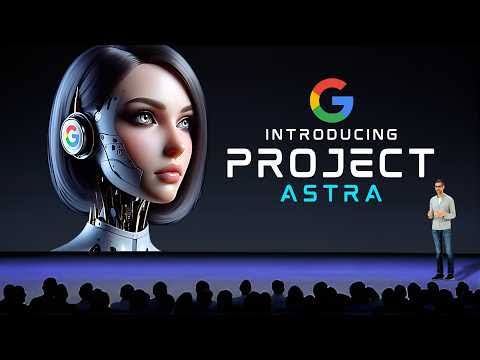
Project Astra represents a significant step forward in Google’s pursuit of creating truly helpful and context-aware AI. It’s an initiative focused on developing a universal AI assistant that can understand and interact with the world around it in real-time, utilizing multimodal inputs.
At its core, Project Astra aims to bridge the gap between digital information and the physical world. This is achieved through advanced AI models capable of processing and interpreting visual and auditory data simultaneously. Imagine an AI that can not only hear your voice but also “see” what you see, understanding the context of your surroundings.
One of the most compelling aspects of Project Astra is its potential for ambient computing. The concept of ambient computing envisions a future where technology seamlessly integrates into our lives, providing assistance and information without requiring conscious effort. Project Astra embodies this vision, acting as a proactive and intuitive companion.
The demonstrations of Project Astra have showcased its remarkable capabilities. For instance, it can answer questions about objects in its field of view, provide real-time information about its surroundings, and even help locate misplaced items. This level of environmental awareness is a significant advancement in AI technology.
A crucial element of Project Astra’s functionality is its ability to remember and recall information about its environment. This allows it to provide contextually relevant assistance, even when dealing with complex or dynamic situations. For example, it could remember where you placed an object and guide you back to it later.
The project also highlights the importance of multimodal interaction. By combining visual and auditory inputs, Project Astra can gain a more comprehensive understanding of its environment. This approach allows for more natural and intuitive interactions, mirroring how humans perceive and interact with the world.
Google’s emphasis on real-time processing is another key aspect of Project Astra. The AI is designed to respond quickly and accurately to user queries, providing immediate assistance when needed. This responsiveness is essential for creating a truly seamless and helpful user experience.
The potential applications of Project Astra are vast and diverse. It could revolutionize fields such as education, healthcare, and accessibility, providing personalized assistance and support to individuals in various settings.
In the realm of education, Project Astra could act as a personalized tutor, providing real-time explanations and guidance to students as they explore their surroundings. In healthcare, it could assist medical professionals by providing instant access to patient information and helping with diagnostic procedures.
For individuals with disabilities, Project Astra could provide invaluable assistance with daily tasks, enhancing their independence and quality of life. It could help with navigation, object recognition, and communication, among other things.
The development of Project Astra also raises important ethical considerations. As with any powerful AI technology, it’s crucial to ensure responsible development and deployment. This includes addressing issues such as privacy, security, and bias.
Google is committed to addressing these ethical considerations and ensuring that Project Astra is used in a way that benefits society as a whole. This includes working with experts and stakeholders to develop guidelines and best practices for AI development and deployment.
Project Astra represents a significant milestone in the evolution of AI. It demonstrates the potential for AI to become a truly helpful and integrated part of our lives, providing assistance and information in a natural and intuitive way.
As the technology continues to evolve, it’s likely that we will see even more innovative applications of Project Astra emerge. This project has the potential to transform how we interact with technology and the world around us.
The integration of such a product into smart glasses, like in the demonstrations, gives a very futuristic feeling. It brings to mind what science fiction has been showing us for decades. That being said, it is very exciting to see this technology becoming closer to reality.
It is important to remember that this technology is still in development. The demonstrations shown are prototypes, and there is still a lot of research and development to be done.
However, the potential of Project Astra is undeniable. It represents a significant step towards a future where AI is truly integrated into our lives, providing assistance and information in a seamless and intuitive way.
In conclusion, Project Astra is a groundbreaking AI project that has the potential to revolutionize how we interact with technology and the world around us. Its focus on multimodal interaction, real-time processing, and contextual awareness makes it a significant advancement in the field of AI.
 Prince Wealth